
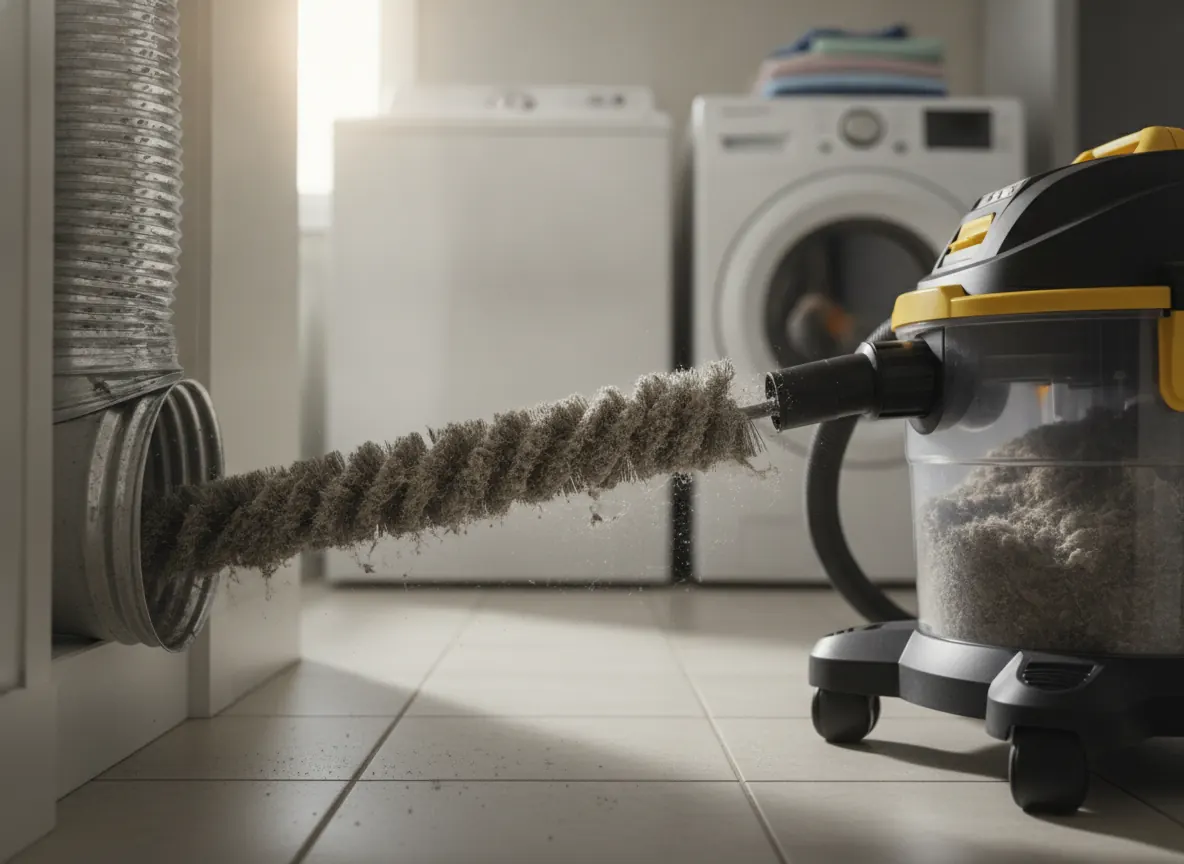
"How often should I have my dryer vent professionally cleaned?" is one of the most common questions homeowners ask, and the honest answer is that the experts don't all agree. Fire-safety groups lean toward once a year. Some dryer manufacturers say every one to two years. And the right schedule for your home depends a lot on how your vent is built and how much laundry you do.
Below, we've put the main recommendations side by side, explained what makes a vent clog faster, and covered whether dryer vent cleaning is really necessary. Birmingham Dryer Vent Cleaning is a free quote service: we connect Birmingham-area homeowners with independent local dryer vent cleaning companies for free, no-obligation quotes.
What the experts recommend
| Source | Recommended vent cleaning |
|---|---|
| NFPA (National Fire Protection Association) dryer safety tip sheet | Once a year, or more often if drying takes longer than normal |
| GE Appliances | At least once a year, even without a "Check Vent" alert |
| Whirlpool | Every one to two years, or as needed when drying performance drops; its blog says at least once every two years unless your manual says otherwise |
| Maytag | Every two years, more often with heavy use |
| Samsung (Canada support) | Once or twice a year |
The NFPA tip sheet puts it this way: "Once a year, or more often if you notice that it is taking longer than normal for your clothes to dry, clean lint out of the vent pipe or have a dryer lint removal service do it for you."
So the range runs from twice a year to every two years. A simple way to read it: NFPA and GE say at least once a year, and some manufacturers say every one to two years. Long, roof or second-floor runs and homes with pets clog faster. If you are unsure, once a year is the cautious middle of the road, and your own dryer's manual is worth checking too.
Don't forget the lint screen
Vent cleaning and lint screen cleaning are two different jobs. The CPSC recommends cleaning the lint screen "before or after drying each load of clothes." That habit keeps a lot of lint out of the duct in the first place. ABC 33/40 reported in 2017 that Hoover fire officials gave the same advice: clean the lint filter before every use, and wash it with soap and water if you use dryer sheets.
A clean lint screen does not mean a clean vent, though. Some lint always gets past the screen and settles in the duct, which is why the vent itself needs periodic cleaning.
What makes a dryer vent clog faster
If any of these describe your home, lean toward the more frequent end of the range:
- Long vent runs. The farther the air has to travel, the more chances lint has to settle. The residential code limits length for this reason (see our guide to the 35-foot dryer vent rule).
- Lots of elbows. Every turn slows the air and gives lint a place to collect.
- Roof and second-floor vents. Air has to travel up, often through an attic, and the vent is harder to check. See roof and second-story dryer vents.
- Pets. Pet hair adds to what ends up in the duct.
- Heavy use. Large households or daily laundry mean more lint, sooner. Maytag specifically calls for more frequent cleaning with heavy use.
- Foil or plastic transition duct. The CPSC notes this type of duct "can more easily trap lint and is more susceptible to kinks or crushing."
- Older homes with retrofitted vents. Census data shows that roughly 70 to 76 percent of homes in Mountain Brook, Bessemer, Birmingham and Homewood were built before 1980. In older homes, laundry rooms and vents may have been added or moved over the years, which can leave long or awkward vent routes.
Signs you shouldn't wait for the calendar
A schedule is a baseline, not a rule. If you notice any of these, have the vent checked now rather than at the next yearly date:
- Clothes are still damp after a normal cycle, or loads take longer than they used to. The CPSC calls this "a sign that the lint screen or the exhaust duct is blocked."
- Weak or no airflow at the outside vent while the dryer runs.
- The dryer or laundry room feels unusually hot.
- A "Check Vent" or airflow warning on the dryer.
- Lint on the siding around the hood, or nesting material in the flap.
Our full list of signs your dryer vent is clogged goes into each one.
Is dryer vent cleaning really necessary?
It is a fair question, especially if your dryer seems to work fine. Two points from the national data are worth knowing. The NFPA found that "one-third (32 percent) of dryer fires were caused by a failure to clean," based on home structure fires from 2014–2018. The U.S. Fire Administration, looking at residential building fires from 2008–2010, found that "failure to clean (34 percent) was the leading factor contributing to the ignition of clothes dryer fires."
The key word is "clean." Lint buildup is something you can prevent with routine maintenance. That makes it one of the more preventable causes. There are practical benefits too: a clear vent lets clothes dry faster, which means shorter cycles. Our article on dryer fire statistics explains what those numbers do and don't mean.
Can you clean a dryer vent yourself?
Often, yes, for part of the job. If your vent is short, runs straight out a first-floor wall and you can easily reach both ends, a homeowner can disconnect the transition duct, vacuum it out and clear the exterior hood. Store-bought brush kits can help on simple runs.
A professional visit makes more sense when the run is long, has several turns, goes through an attic or exits on the roof. On a typical visit, a technician will usually measure airflow before and after, run a rotary brush and vacuum through the full length of the duct, clear the exterior hood or cap, and point out problems such as crushed or disconnected duct. Some companies also use a camera to look inside the run. Read more about the dryer vent cleaning service and the typical process.
How much does a yearly cleaning cost?
Typical national ranges from HomeAdvisor (2026), Fixr (2025) and Bob Vila (2024), which are estimates and not quotes:
| Item | Typical range |
|---|---|
| Dryer vent cleaning, overall | about $104–$188 (HomeAdvisor avg about $145; full range $75–$340) |
| First floor / basement vent | $80–$175 |
| Second-floor vent | $110–$200 |
| Roof vent | $150–$300 |
| Inspection / airflow check | $30–$60 |
The real price depends on vent length, stories, roof access and condition. Our dryer vent cleaning cost guide has the complete table.
A simple schedule for most Birmingham homes
Every load
Clean the lint screen.
Every few months
Run the dryer and check for strong airflow at the outside vent. Look behind the dryer for crushed or disconnected duct.
Once a year (or per your manual)
Have the full vent run cleaned, especially for long, roof or second-floor vents, homes with pets or heavy laundry use.
Any time
Call for a check if drying slows down, the dryer runs hot or you see signs of birds or pests.
Ready to get your vent on a schedule? Request a free quote and we'll connect you with independent local dryer vent cleaning companies in Birmingham, Hoover, Vestavia Hills, Homewood and nearby. Call (727) 300-6656