
A clogged dryer vent rarely fails all at once. Lint builds up a little with every load, airflow drops a little at a time, and the dryer slowly works harder to do the same job. The good news is that the warning signs are easy to spot once you know them. This guide covers seven of the most common signs your dryer vent needs cleaning, a few quick checks you can do yourself, and when it is worth calling a professional.
A quick note on who we are: Birmingham Dryer Vent Cleaning is a free quote service. We connect Birmingham-area homeowners with independent local dryer vent cleaning companies for free, no-obligation quotes. We don't do the work ourselves, so this guide is about helping you understand what you are seeing before you talk to anyone.
Why a dryer vent clogs in the first place
Your dryer's lint screen catches most of the lint, but not all of it. The rest rides the warm, moist exhaust air through the duct behind the dryer, through the wall or ceiling, and out the hood on the outside of the house. Lint settles wherever the air slows down: in elbows, in sagging or crushed sections, at joints, and right at the exterior flap. The U.S. Consumer Product Safety Commission (CPSC) puts it plainly: "Lint can block the flow of air, cause excessive heat build-up, and result in a fire in some dryers."
Some vents clog faster than others. Long runs, runs with several elbows, roof and second-floor vents, and flexible foil or plastic ducts all tend to trap more lint. If your home has any of those, keep a closer eye on the signs below.
1. Your clothes take forever to dry
This is the classic sign, and it is the one the CPSC names directly: "If clothing is still damp at the end of a typical drying cycle or drying requires longer times than normal, this may be a sign that the lint screen or the exhaust duct is blocked."
If a normal load of towels used to take one cycle and now takes two, the dryer may not be the problem. When moist air can't leave the drum quickly, the clothes simply stay damp longer. Before you assume the dryer is failing, clean the lint screen and check the vent.
2. Little or no air coming out of the outside vent
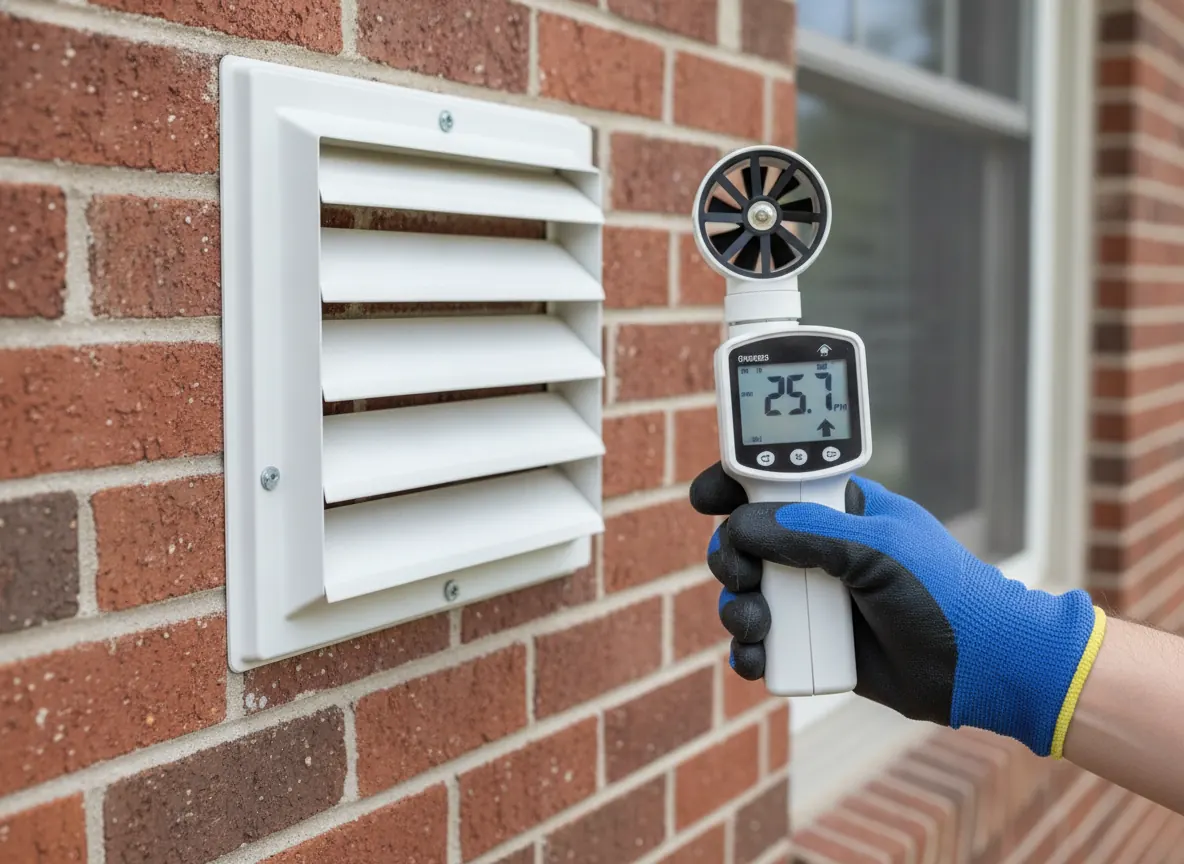
The CPSC also recommends that you "check the outside dryer vent while the dryer is operating to make sure exhaust air is escaping." Start a load on a heat setting, walk outside and find the vent hood. You should feel a steady stream of warm air and see the flap open. A weak puff, no air at all, or a flap that barely moves points to a blockage somewhere in the run, or a duct that has come apart inside the wall.
3. The dryer or laundry room gets unusually hot
A dryer that can't push its exhaust out keeps that heat inside. You may notice the top of the dryer is hotter than it used to be, the clothes are very hot to the touch at the end of the cycle, or the laundry room feels warm and stuffy. That excess heat is exactly what the CPSC warns about. If you notice it, stop running long cycles and get the vent looked at.
4. Your dryer shows a "Check Vent" or similar alert
Many newer dryers monitor airflow and show a vent warning when exhaust is restricted. GE Appliances, for example, advises cleaning the vent at least once a year even if you never see a "Check Vent" alert. If the light does come on, treat it as a real sign, not a glitch. Clean the lint screen first, then look at the duct behind the dryer and the outside hood.
5. Lint around the outside hood, or a flap that is stuck
Look at the vent from outside. Lint stuck to the siding or brick around the hood, lint packed behind the louvers, or a flap that stays partly open (or won't open at all) all suggest the exhaust is struggling. On a roof vent you may see lint collected around the cap. Roof and second-story vents are harder to check and harder to clean, which is why they often go longest between cleanings. Our guide to roof and second-story dryer vents explains what is involved.
6. A crushed, kinked or foil duct behind the dryer
Pull the dryer out a few inches and look at the transition duct, the short piece that connects the dryer to the wall. The CPSC notes that flexible plastic or foil ducting "can more easily trap lint and is more susceptible to kinks or crushing, which can greatly reduce the airflow," and recommends replacing plastic or foil accordion-type duct with rigid or corrugated semi-rigid metal duct. ABC 33/40 has also passed along the tip not to push the dryer tight against the wall, since that can crush the vent.
If the duct is flattened, torn, disconnected or made of plastic, cleaning alone may not fix the problem. See dryer vent repair and replacement for what a fix usually looks like.
7. Birds, nesting material or animal sounds at the vent
Twigs and grass sticking out of the hood, chirping inside the wall, or scratching sounds near the laundry room mean something has moved in. A nest blocks airflow just like lint does, and nests are made of dry, flammable material. In 2017, ABC 33/40 reported that a Hoover fire spokesperson described a fire that started after a squirrel crawled through an outside vent and died. If you suspect an animal, don't run the dryer until the vent is cleared, and identify the species before anything is removed: active nests of protected native birds can't be destroyed under federal rules, while house sparrows and starlings are not protected under the Migratory Bird Treaty Act. Read more in bird nest and pest removal from dryer vents.
Quick checks you can do today
- Clean the lint screen before or after every load, as the CPSC recommends.
- Run the dryer and feel for strong, warm airflow at the outside hood.
- Look behind the dryer for crushed, kinked, disconnected or foil/plastic duct.
- Check the outside hood for lint buildup, a stuck flap or nesting material.
- Note how long a normal load takes now, so you have something to compare against after a cleaning.
If you use dryer sheets, ABC 33/40 also reported advice from Hoover fire officials to wash the lint filter with soap and water from time to time.
When to stop using the dryer: if you smell something burning, see scorch marks, or the dryer shuts itself off from overheating, stop using it and have the dryer and vent checked before running another load.
When to call a professional
A homeowner can handle the lint screen, the transition duct and a reachable exterior hood. It is worth calling a dryer vent cleaning company when:
- Drying is still slow after you clean the lint screen and the transition duct.
- The vent run is long, goes through an attic or exits on the roof or a second floor.
- You can't feel airflow outside, or you can't find where the vent exits.
- There is a nest, an animal or a bad smell in the vent.
- The duct is damaged, disconnected or made of foil or plastic.
On a typical visit, a technician will usually take an airflow reading, look at the transition duct and exterior hood, run a rotary brush and vacuum through the full length of the duct, then check airflow again. Some companies also use a camera to look inside the run. Our step-by-step process page walks through what to expect, and the dryer vent cleaning page covers the service in more detail.
What does it cost?
Typical national ranges from HomeAdvisor (2026), Fixr (2025) and Bob Vila (2024) put a standard dryer vent cleaning at about $104–$188, with a HomeAdvisor average of about $145 and a full range of $75–$340. An inspection or airflow check alone typically runs $30–$60, and roof vents run higher, around $150–$300. These are estimates, not quotes. The real price depends on vent length, stories, roof access and condition. See the full dryer vent cleaning cost guide for every item.
Not sure how often your vent needs attention?
Even if you don't see any of these signs yet, regular cleaning keeps them from showing up. NFPA and GE say at least once a year, and some manufacturers say every one to two years. Our guide on how often to clean your dryer vent lays out what each source says.
If you've noticed one or more of these signs, the simplest next step is to request a free quote. Tell us how long your loads take, where the vent exits and how many stories your home has, and we'll connect you with independent local companies serving Birmingham and the surrounding cities. Call (727) 300-6656