
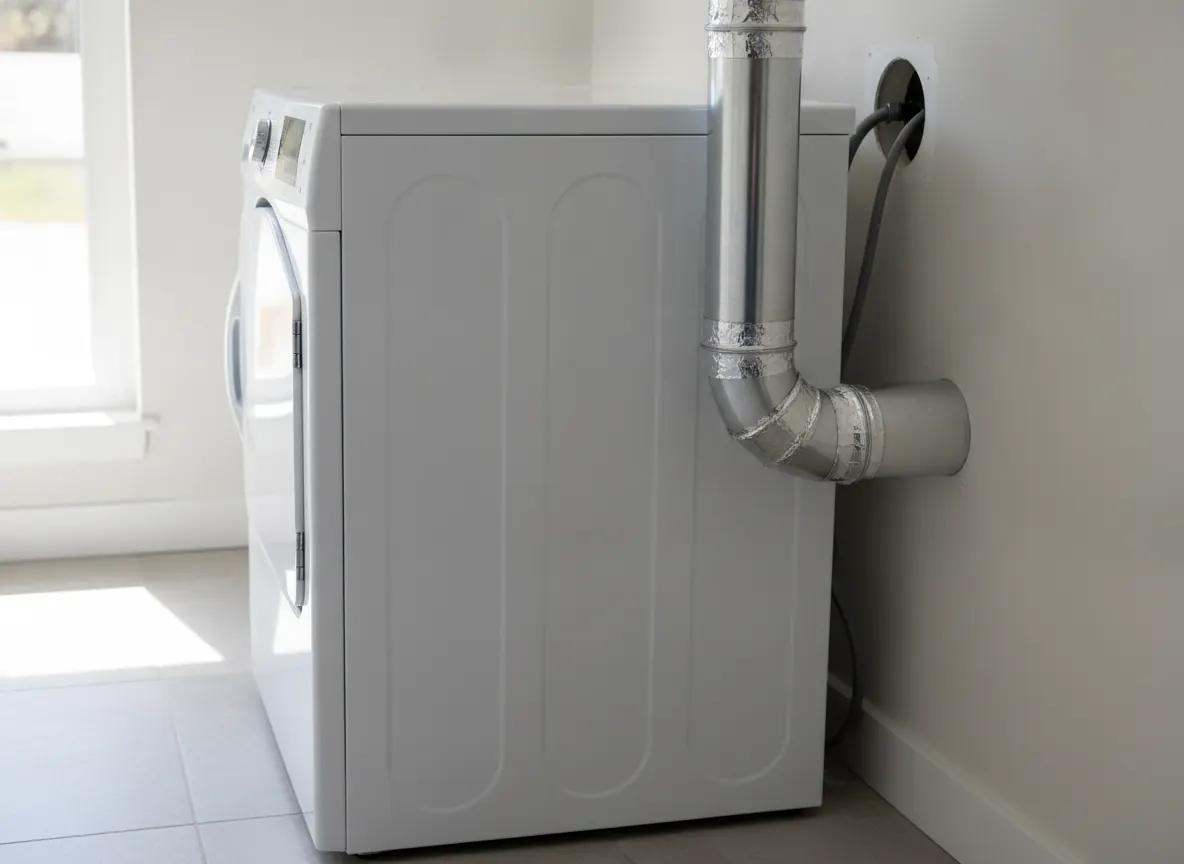
Can a dryer vent hose be too long? Yes. Every foot of duct and every turn adds resistance, and when the exhaust air slows down, lint settles and drying times stretch out. That is why the residential building code puts a limit on how long a dryer exhaust duct can be, and why elbows count against that limit.
This guide explains the rule in plain language: the 35-foot maximum, how fittings are deducted, the label requirement for longer runs, and the difference between an allowed power ventilator and a prohibited booster fan. Birmingham Dryer Vent Cleaning is a free quote service: we connect Birmingham-area homeowners with independent local dryer vent cleaning companies for free, no-obligation quotes. This is general information, not legal advice.
The basic rule: 35 feet
The International Residential Code, which Alabama has adopted with amendments, says: "The maximum length of the exhaust duct shall be 35 feet from the connection to the transition duct from the dryer to the outlet terminal. Where fittings are used, the maximum length… shall be reduced in accordance with Table…" It also says: "The maximum length of the exhaust duct does not include the transition duct."
Two things are worth noticing:
- The measurement starts at the wall, not the dryer. The 35 feet runs from where the transition duct connects to the fixed duct, out to the vent hood or cap on the outside of the house.
- 35 feet is the limit for a straight run. Every elbow uses up part of that allowance, so a run with several turns has to be shorter in actual length.
The code also allows two alternatives: following the dryer manufacturer's installation instructions (with a copy provided to the code official at the concealment inspection), or following the manufacturer's instructions for a listed dryer exhaust duct power ventilator. More on that below.
How elbows count: the fitting table
Each fitting has an "equivalent length" that is subtracted from the 35-foot maximum. Tighter turns cost more. Here are the values as printed in the 2015 IRC table (check the edition your local code official enforces before relying on exact figures):
| Fitting (4-inch duct) | 45° bend | 90° bend |
|---|---|---|
| 4-inch radius, mitered | 2 ft 6 in | 5 ft |
| 6-inch radius, smooth | 1 ft | 1 ft 9 in |
| 8-inch radius, smooth | 1 ft | 1 ft 7 in |
| 10-inch radius, smooth | 9 in | 1 ft 6 in |
The takeaway: a sharp, mitered 90-degree elbow costs 5 feet of allowance, while a long, smooth sweep elbow costs well under 2 feet. Choosing smooth, larger-radius elbows can make the difference between a run that meets the limit and one that doesn't.
A worked example
Say your dryer sits on an interior wall. The fixed duct runs 12 feet up into the attic, 14 feet across, and out through a wall. It has three 90-degree turns.
- With mitered 4-inch-radius elbows: 26 feet of duct + (3 × 5 ft) = 41 feet equivalent. That is over 35.
- With smooth 6-inch-radius elbows: 26 feet + (3 × 1 ft 9 in) = 26 + 5.25 = 31.25 feet equivalent. That is under 35.
Same route, same duct length, different result. This is why a technician looking at a slow-drying dryer will often ask how the vent is routed, not just how long it is.
Does a dryer vent hose need to be straight?
Not perfectly straight, but straighter is better. The code doesn't ban turns; it charges for them. The practical goals are the shortest reasonable route, as few elbows as possible, and smooth, larger-radius elbows where turns are needed. Sags and kinks also matter: the code requires the duct to be supported at intervals of no more than 12 feet, and a low spot or a flattened section collects lint even if the total length is within the limit.
The label rule for long runs
Some homes have dryer locations where a run over 35 equivalent feet is allowed under the manufacturer's instructions. In that case, the code says the length "shall be identified on a permanent label or tag… within 6 feet of the exhaust duct connection." If you see a tag like that near your laundry hookup, it tells you (and any future technician) that the run is longer than the standard limit. Longer runs generally deserve more frequent cleaning; see how often to clean your dryer vent.
Other duct rules that go with the length limit
Length is only one part of the picture. The same IRC section also requires:
- 4-inch smooth metal duct. The exhaust duct must have a smooth interior finish, be made of metal at least 0.0157 inches thick (No. 28 gage), and be 4 inches nominal in diameter.
- No long screws inside the duct. Ducts "shall not be joined with screws or similar fasteners that protrude more than 1/8 inch" into the inside of the duct. Long screws snag lint.
- Joints in the direction of airflow. The insert end of each piece points toward the outside, and joints are sealed and mechanically fastened.
- A short, listed transition duct. The connector behind the dryer must be a single length listed and labeled to UL 2158A, no longer than 8 feet, and it must not be concealed inside walls or ceilings.
- A backdraft damper and no screens at the termination. The duct must end outside the building with a backdraft damper, and "screens shall not be installed at the duct termination." Screens catch lint and clog. If birds are a concern, the code-compliant answer is a proper damper cap plus regular cleaning; see dryer vent cover replacement.
- Clearance from openings. If the dryer manufacturer doesn't specify a location, the termination must be at least 3 feet in any direction from openings into the building.
Booster fans vs. power ventilators
If a vent run is too long, it is tempting to add a fan. Here the wording matters. The 2021 IRC says: "Domestic booster fans shall not be installed in dryer exhaust systems." A generic inline booster fan is not an approved fix.
What the code does recognize is a dryer exhaust duct power ventilator that conforms to UL 705. These are listed devices designed specifically for dryer exhaust, and the code allows a longer run when it follows the power ventilator manufacturer's instructions. If someone suggests a fan for your dryer vent, ask whether it is a UL 705 listed dryer exhaust duct power ventilator, and confirm the details with your local code official.
What if your vent is too long?
If drying is slow and the vent run is long or full of elbows, the usual options are:
Clean it first
A long run that hasn't been cleaned may simply be clogged. Start with a full dryer vent cleaning and a before-and-after airflow reading.
Fix the weak spots
Replace crushed transition duct, swap foil or plastic for metal, and replace sharp elbows with smooth sweeps where possible.
Reroute
A shorter path to an outside wall can cut length and turns. Check with your city's permit office for new vent routes through walls or the roof.
Consider a listed power ventilator
Where rerouting isn't practical, a UL 705 listed dryer exhaust duct power ventilator may be an option under the code.
Typical national ranges from HomeAdvisor (2026), Fixr (2025) and Bob Vila (2024), as estimates and not quotes: a reroute or new vent run is about $200–$500 (duct replacement $175–$600), and minor repairs are about $75–$150. The real price depends on vent length, stories, roof access and condition. See the dryer vent repair and replacement page and our cost guide for more.
Not sure whether your vent is within the limit? Request a free quote and describe the route, the number of turns and where the vent exits. We'll connect you with independent local companies serving Birmingham and nearby cities. Call (727) 300-6656